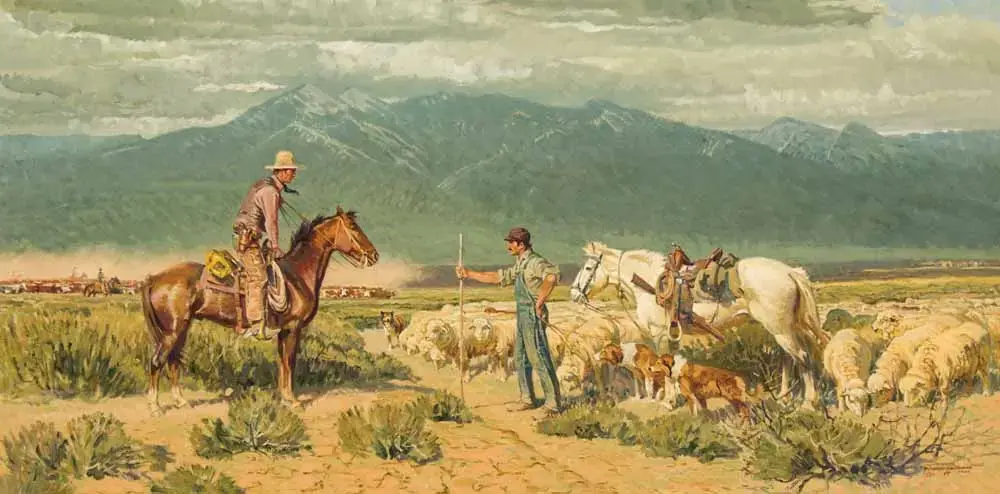
Robert Lougheed
1910-1982
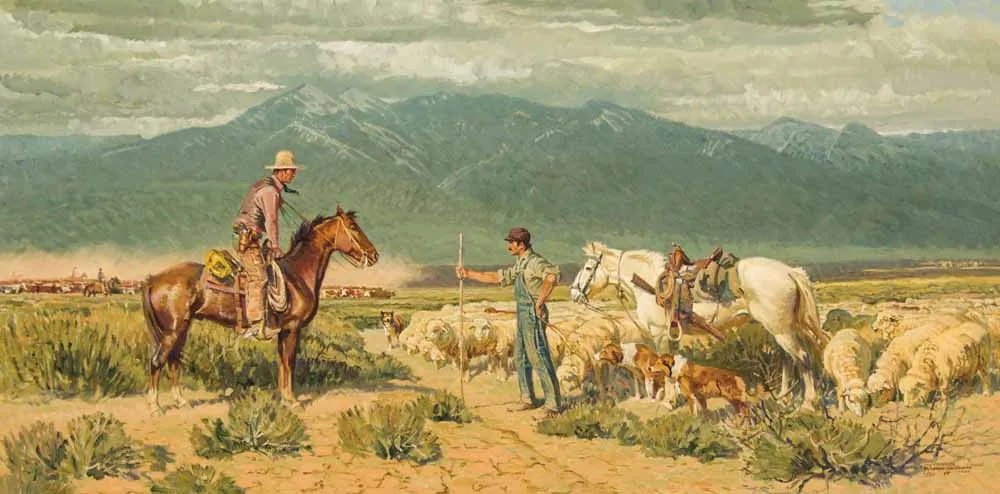
Open Range Encounter
MEDIUM: Oil on canvas
DIMENSIONS: 30 1/4 x 60 inches
Signed lower right/NAWA
Titled, signed and dated 1976 verso
SHIPPING DIMENSIONS: 41 x 71 inches
SOLD FOR: $60,000.00
Including Buyers Premium
Additional Information
Provenance:
Private Collection, Paradise Valley, AZ, by descent
Jackson Hole Art Auction, Jackson Hole, WY, 2016
Private collection, Texas
Literature:
Lougheed: A Painter’s Painter, B. Byron Price, Nygard & Elliott Publishing Company, Bozeman, MT, 1991, p. XV (15)
On first viewing, Robert Lougheed’s Open Range Encounter might seem like a pleasant meeting between two strangers. But further examination—including in the title with the ominous word “encounter”—reveals a tense confrontation between a cattle-driving cowboy and a sheepherder with his flock. The man with the sheep has planted his walking stick into the desert soil, a sign of his firm resolve in the matter at hand. The cowboy, who has stood up in the stirrups, seems to suggest a sense of disbelief as he witnesses the sight before him. Even the subjects’ clothing shows the vastly different worlds these men come from: the cowboy is in classic gear with vest, holstered gun and chaps, while the sheepherder is in denim overalls and a short-billed hat. Lougheed underlines the demarcation between the two men by placing a bare border-like patch of dirt that marks the opposing sides. Although the painting’s location is not identified, based on other Lougheed paintings it may be set near San Antonito, New Mexico.
Lougheed started his art career in his native Canada, before moving to New York to study with Frank Vincent Dumond at the Arts Students League. His move to the United States came as advice from friend and fellow illustrator John Clymer. He worked consistently throughout the 1930s through 1950s. In 1960, he was commissioned by National Geographic magazine to paint 13 works showing various horse breeds in America. As part of the assignment, he visited the historic Bell Ranch in New Mexico. It would change his life forever. “Cattle ranching in the West had changed hardly at all in almost one hundred years, and Bob might have believed he had wandered into another world and another time,” wrote Don Hedgpeth in Follow the Sun: Robert Lougheed. “His artistic instincts were stirred at the sight of a panorama of cattle and horses and men moving in a cloak of dust across a landscape uncluttered by any sign of modern civilization. It all seemed so different from the way Western novels and movies had said it was. Bob knew he was seeing something special, something grand and on a scale that could not be translated into art in the ordinary manner. He came away from the Bell Ranch in the fall of 1960 with much more than the material for a horse picture for National Geographic. The way Bob saw it, ‘The West is too big to be confined within the boundaries of the canvas. It is necessary to create the impression of a landscape that moves into the painting from one side and continues on out the other. This is when I started to paint the long proportion—twice the length of the depth.’”