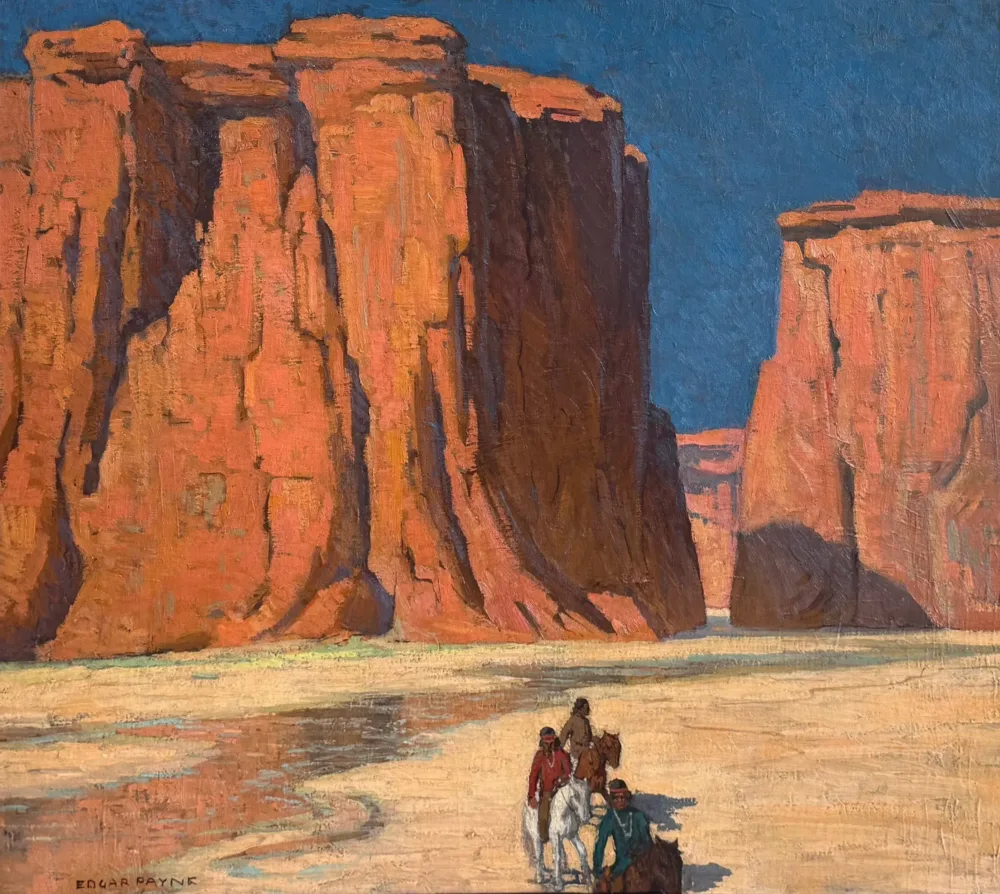
Edgar Payne coming to April Auction
Nov 10, 2026 | Featured Artists

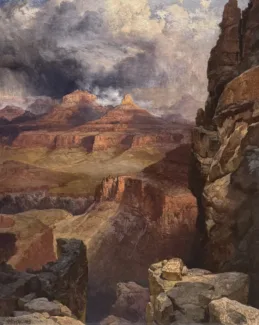
Few artists are as closely linked to their subjects as Thomas Moran is to the Grand Canyon. The English painter, already famous for his paintings of Yellowstone, first laid eyes on the “Grand Cañon of the Colorado” in August 1873 during an expedition with John Wesley Powell, who had, four years earlier, led a geological survey through the iconic Arizona landmark. Moran, seeing the vastness of the canyon and its limitless beauty, immediately started sketching on location and preparing for large oils upon his return to his New York studio.
The work, titled simply Grand Canyon, was painted in 1908, many years after his initial adventure with Powell in 1873. Although the painting could have originated earlier than 1908, Moran did visit the Grand Canyon in the summer of that year, just five months after it was named a national monument by President Theodore Roosevelt. Moran and his daughter, Ruth, spent two months in Arizona, with one newspaper noting that, “Mr. Moran has already painted many pictures depicting scenes in that region, which have become quite famous.” Although the location in Grand Canyon is not noted, it is thought to be Brahma Temple and Zoroaster Temple as seen from the South Rim. While he frequently painted realistic scenes of his subjects, Moran also combined natural elements from different locations to make a more pleasing composition.
Moran’s thoughts on the canyon remained steadfast throughout his career, but they were crystalized immediately during that first 1873 trip, which is obvious in his writing back home. In one letter to his wife, Moran begins to compare the canyon to Niagara Falls, but then makes a pivotal deviation into spirituality and science.
“At the Grand Cañon, the feeling of grandeur is not produced by power in activity, for the river is too far away, and forms too insignificant a part of the scene. Nor is it produced by the vastness of the chasm alone, for every one has seen other things giving a more distinct impression of great extent or size,” he writes. “I think the feeling is one of awe and wonder at the evidence of some mighty, inconceivable, unknown power, at some time terribly majestically, and mysteriously energetic, but now ceased. And yet the force that has wrought so wonderfully through periods unknown, unmeasured, and unmeasurable, is a river 3,000 feet below, so far away that one never thinks of it as an agency capable of such a work. Nor, indeed, without study and investigation and reflection can it be conceived that its ceaseless motion, through myriads of years, may have eroded and worn its rocky channel through plains and mountains, to such a depth that, in places, Mount Washington, plucked up by the roots, as Milton’s contending legions plucked the heavenly hills, and thrown into the chasm, would not appear above the brink, nor form a dam for the rushing river.”
This work will be included in the furthering Thomas Moran catalogue raisonné.
Subscribe to our email list to hear about upcoming auctions, events, and news.